New SARS Customs Codes for Copper, Abalone, Batteries — Comment by 18 August
SARS's "technical" tariff amendments re-code copper scrap, abalone, lithium cells and steel from 1 January…
Saudi operator RSGT is weighing a 25-year Duncan Dock concession. COSCO owns a fifth of it — and nine of Cape Town's eleven terminals are already private.
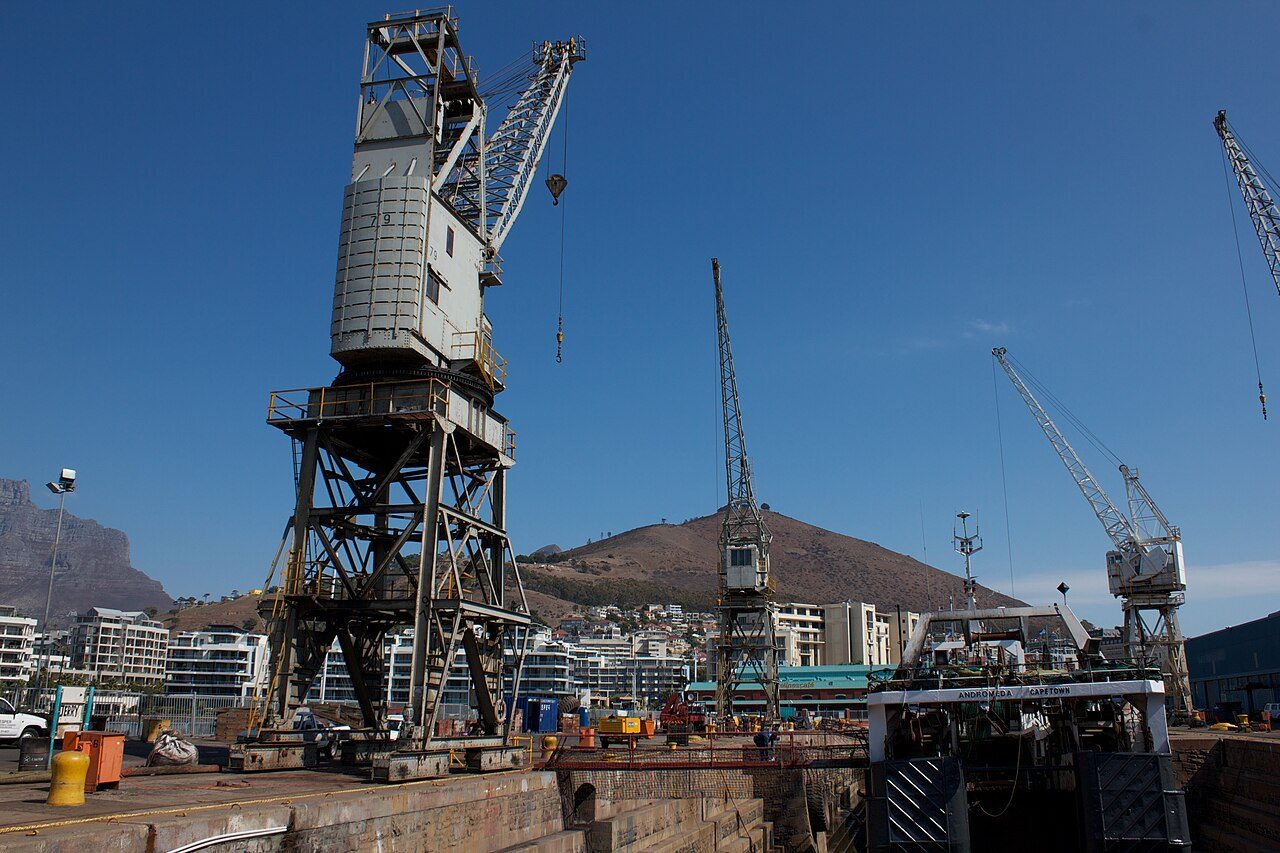
Bids for a 25-year concession over 119,849 square metres of the Port of Cape Town close on 20 November, and on 6 August a Jeddah terminal operator sat in the briefing room to decide whether to file one. Red Sea Gateway Terminal is the name in the headlines. The more consequential name is on its share register: COSCO Shipping Ports owns 20% of RSGT, alongside 20% held by Saudi Arabia's Public Investment Fund. A bid that reads as Gulf capital arriving in the Western Cape is also, in part, Chinese state capital arriving — in the same year South Africa's tariff exposure in Washington turns on precisely that alignment.
Transnet National Ports Authority issued the request for proposals on 23 July for the Duncan Dock Precinct, one of two multi-purpose terminals at the port. The winning bidder takes on the "design, financing, refurbishment, construction, operation, maintenance and eventual transfer" of what TNPA calls a modernised, energy-efficient terminal, over 25 years. The tender exists because the incumbent's lease runs out in 2027. The non-compulsory bidders' briefing was held at the port on 6 August; RSGT's director of global investments, Gagan Seksaria, confirmed the company attended to evaluate participation.
Two details in the RFP deserve more attention than they have had. TNPA named no investment figure — the capital commitment is whatever bidders propose, which makes the eventual number a negotiated outcome rather than a published requirement. And the new operator may acquire the existing terminal equipment, which quietly determines how much of the promised modernisation is new steel and how much is a change of nameplate on the cranes already standing there.
The tender is being received as a remedy for a port with a genuinely dire record. It is worth being precise about what it can and cannot repair. Nine of the Port of Cape Town's eleven terminals are already privately operated. Private operation is not the missing variable in Cape Town; it is the prevailing condition.
Nor is Duncan Dock the facility that earned the port its reputation. The World Bank's 2025 Container Port Performance Index — which measures one thing, the hours a ship spends between arrival and departure — placed Cape Town last of more than 400 ports assessed. That verdict was delivered on the container terminal, and Cape Town's binding constraint there is wind-driven crane stoppages and landside evacuation, neither of which is cured by re-tendering a multi-purpose berth a few hundred metres away. A refurbished Duncan Dock is a real improvement to break-bulk and dry-bulk handling. It is not a fix for vessel time in port.
The Duncan Dock berths are where Western Cape fruit goes to sea. The precinct has long been the home of the port's fresh-produce handling, and deciduous fruit, table grapes and citrus move through it on a season that does not negotiate. For an exporter, a concession change at that quay is not an abstraction about foreign investment — it is a question about who owns the reefer plugs, the cold rooms and the gang scheduling during the weeks when the crop is either on the water or on the compost heap.
Three practical consequences follow from the dates. First, nothing changes for the 2026/27 season: bids close 20 November, and the incumbent's lease runs into 2027, so the fruit currently being budgeted for moves under existing arrangements. Second, the handover — whenever it lands — will fall somewhere inside a fruit calendar, and refurbishment works at a live terminal are exactly the conditions under which demurrage and missed sailings appear. Third, a 25-year concession is a 25-year tariff schedule; the rates a new operator needs to service its refurbishment debt are the rates that will sit in Western Cape export costings well into the 2040s.
RSGT is a serious operator, not a speculative bidder. Its Jeddah Islamic Port terminal has a capacity of roughly 6.2 million TEU and handled about 39% of Saudi Arabia's container throughput in 2024. Its international arm, RSGTI, was created in 2022 to take that competence into emerging markets and signed a 22-year concession for Chittagong's Patenga Container Terminal in 2023. On operating capability, South Africa would be getting something real.
The ownership is the part that deserves a debate rather than a press release. COSCO Shipping Ports and the PIF together bought 40% of RSGT for about $280 million, split evenly. COSCO is an arm of the Chinese state and one of the largest container carriers on the planet — which means a successful RSGT bid would place a Chinese state shipping group in the ownership chain of a South African quay while Washington is actively using tariff instruments against South African exporters. That is not an argument for excluding the bid. It is an argument for the government deciding, in advance and in public, whether it has a position on carrier-affiliated ownership of national port infrastructure — because a carrier that part-owns a terminal has interests in berth priority that a neutral operator does not.
This is a good tender and a bad narrative. The tender is genuine: Duncan Dock needs capital, the incumbent lease is expiring anyway, and RSGT can operate a terminal. The narrative — that private money is coming to rescue the world's worst-performing port — collapses the moment you notice that nine of eleven Cape Town terminals are already private and that the last-place ranking was earned at a different terminal by a different constraint.
What to do about it, concretely:
The bid deadline is 20 November. The question worth putting to the dtic and to TNPA before then is not whether foreign capital is welcome — it plainly is, and should be. It is whether South Africa has a rule about carrier-linked equity in its own ports, or whether it is about to acquire one by accident.