Transnet Stakes Its Reform on the Branch Lines It Let Decay
Transnet has invited private capital to fix 9,098km of loss-making branch line — the least…
A software switch at Durban's biggest terminal has cut throughput by a quarter, and the cost of the delay is landing on importers as demurrage they did not earn.
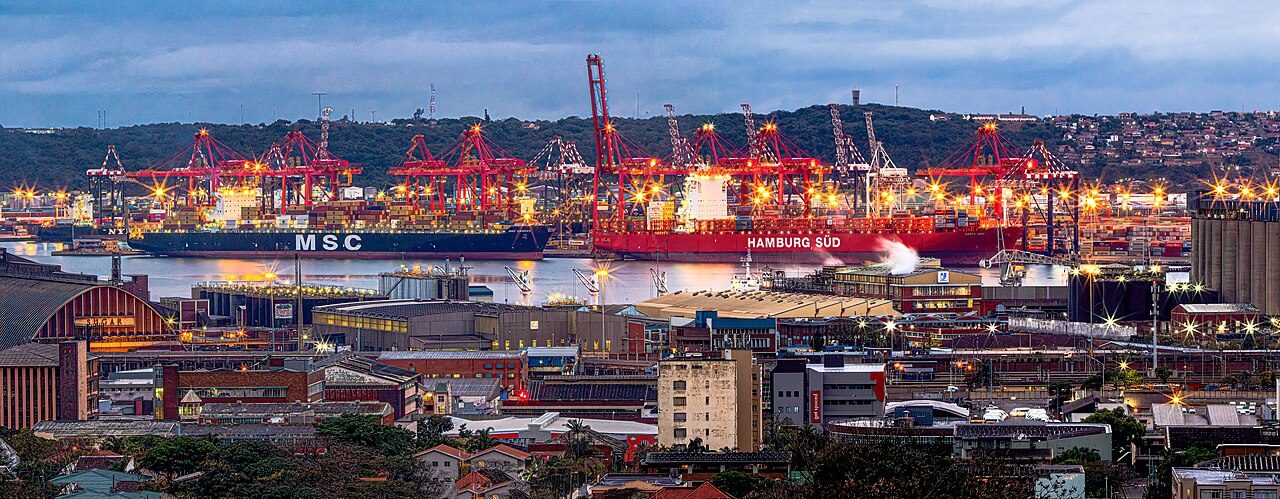
On 2 September, Transnet Freight Rail reopened the Natal Corridor into Durban after a nine-day maintenance shutdown, restoring the rail route that might have drained the container mountain sitting behind South Africa's busiest terminal. It will not be enough. Six weeks after Durban Gateway Terminal (DGT) cut over to a new Navis N4 operating system in mid-August, some vessels are still waiting eight to twelve days for a berth, weekly throughput has fallen by more than a quarter, and the cost of the delay has arrived where importers can argue with it least — on their demurrage invoices.
The delay itself is by now well documented. DGT — the terminal most South Africans still call Durban Container Terminal Pier 2, handling more than 40% of the country's containerised trade under a 25-year concession held by Philippines-based International Container Terminal Services Inc — migrated to its own Navis N4 operating system in mid-August and lost more than a quarter of its weekly throughput in the week that followed. Six weeks on, some lines are still reporting eight-to-twelve-day waits for a berth. DGT chief commercial officer Grant Bahlmann said the system was "stable" as of 26 August, with backlog clearance under way.
Stable, though, is not the same as clear — and a stable system running a twelve-day queue bills exactly as much as an unstable one. The queue has a price, it is itemised, and it is not falling on the people who caused it.
For an importer, port congestion is not an operational abstraction. It is a meter running against a box you cannot collect. Three separate charges attach to a trapped container, and the fight now under way is over who pays them. Terminal storage — the fee once a container's free days at the terminal expire — runs to as much as US$140, about R2,500, per container per day. Demurrage and detention, billed by the shipping line for holding its equipment beyond the free period, add a further US$80 to US$100, roughly R1,420 to R1,775, a day. Several lines have also cut their detention-free window from five days to four, tightening the clock precisely as the queue lengthened.
DGT has waived its own terminal storage charges for containers already inside the terminal until stability returns. That helps, but it addresses only one of the three meters — and it is the terminal's own. Demurrage and detention belong to the shipping lines, which the terminal has merely asked to consider additional free time and relief. An importer whose consignment has sat for nine days is therefore still exposed to the two charges the terminal cannot waive, for a delay caused by a system it does not run. That is the gap between a press release and a landed cost.
Perishables show the sharpest edge. The Citrus Growers' Association reported reefer trucks queuing up to 30 hours to deliver, with some consignments losing quality while standing without power and being rejected for export outright. CGA chief executive Boitshoko Ntshabele's members began weighing a switch to the Port of Maputo — a telling verdict on a South African terminal at the peak of the citrus season.
What separates this from an ordinary bad month at a South African port is that the argument over who absorbs the cost is no longer being had with the terminal. In July, Positive Freight Solutions' container division — representing 140 transporters and roughly 6,000 employees — lodged a complaint with the Competition Commission against eight shipping lines, DGT and Transnet. The named lines are Mediterranean Shipping Company, Maersk South Africa, CMA CGM, Hapag-Lloyd, Ocean Network Express, COSCO, Pacific International Lines and Evergreen.
The complaint's core allegation is that terminal delay is being monetised: vessel operations are prioritised over landside collection, boxes stay trapped for up to nine days, and the resulting demurrage, detention and storage fees fall on cargo owners who did nothing to cause the hold-up. "The truck-booking system is fundamentally broken," said PFS chief executive Alex Hill; slots, he added, are "virtually impossible to secure" even as the storage meter keeps running. Whatever the Commission makes of it, the filing signals that importers and transporters no longer regard these charges as an act of nature to be absorbed.
Maputo is not the escape valve it looks like either. Rerouting landed cost through Mozambique means a longer inland haul, a different customs regime, corridor capacity that fills quickly when everyone has the same idea, and border risk of its own. It is a pressure-relief measure for a citrus grower facing a rejected consignment, not a structural answer for the 40% of the country's containers that move through Durban.
The concession was supposed to prove that private operating discipline could fix a Transnet terminal. Six weeks in, it has instead demonstrated how quickly a botched system cut-over converts into a bill for the people furthest from the decision. The terminal stopped its own clock; the shipping lines did not; and the importer sits in the gap. That gap, not the software, is the story.
Three things are worth doing now rather than after the next invoice. First, treat demurrage and detention as a live line item, not a rounding error: re-price landed-cost assumptions for Durban traffic to include eight to twelve days of delay and the R1,420–R1,775-a-day line charge, and stress-test cash flow against it. Second, do not assume the terminal's storage waiver covers you — get the shipping line's relief position in writing per booking, because that is the meter still running. Third, where a shipment is time-critical or temperature-sensitive, cost the alternative routings honestly against the demurrage exposure before the box lands, not after. The importers who come through this quarter intact will be the ones who read the concession as a cost event, not a good-news announcement.