Transnet's R78 Container Charge Lands Just as Diesel Prices Fall
Transnet Port Terminals lifted its fuel neutrality container charge to a record R78 from 1…
Transnet's container fuel surcharge drops to R52 for August, back where it started — proof the "short-term" levy is now a permanent, monthly-floating line on every box.
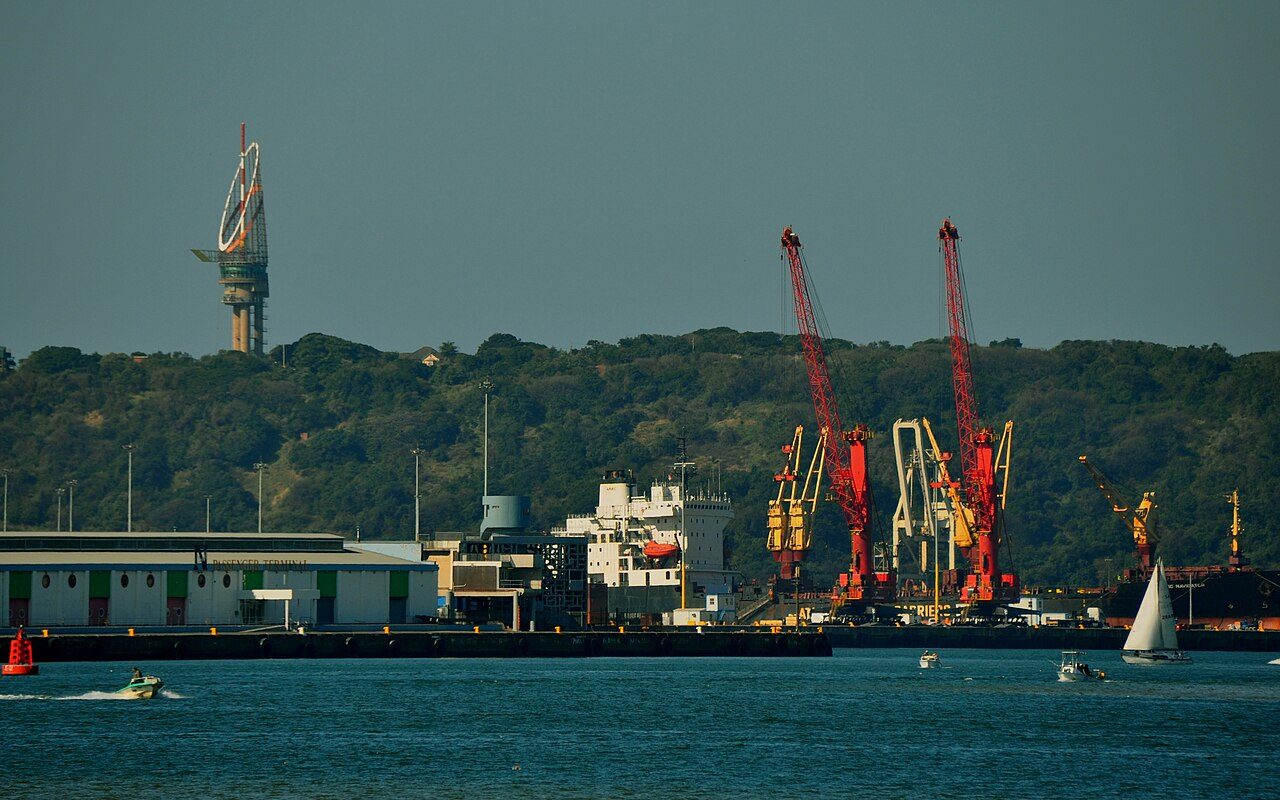
From 1 August the fuel surcharge on every container crossing a Transnet Port Terminals quay falls to R52.00 — back to exactly where it started on 1 May, after a three-month round trip up to R78 and down again. The relief is real but slight. The deeper signal is that a levy Transnet promised would be "short term in nature" has now floated through four consecutive monthly settings, and no importer can any longer quote a fixed terminal-handling cost with a straight face.
The Fuel Neutrality Charge applies per container to every box entering or leaving Transnet Port Terminals and the Durban Gateway terminals. Its stated purpose is to recover the diesel burned by the straddle carriers and rubber-tyred gantry cranes that shift containers on the quay whenever the regulated coastal diesel price runs hot. On the carrier notices passed through to shippers by lines including Hapag-Lloyd and Maersk, the mechanism is precise: the fuel index is reassessed on the seventh of each month and applied to all containers on vessels berthing after 00:01 on the first of the month that follows.
The numbers tell the story of a levy that behaves like a tide. Transnet introduced the charge at R52 a container on 1 May 2026, raised it to R78 for June as diesel climbed, and has now re-set it to R52.00 for vessels berthing from 1 August, based on a coastal diesel price of R23.91 a litre as at 1 July. The thresholds are tied to the regulated fuel-pricing framework administered by the Department of Mineral and Petroleum Resources, and Transnet maintains the charge is temporary — levied only during "periods of extreme fuel price variation". Three billing cycles in, that framing is doing a lot of work.
The charge lands squarely on the importer and exporter, because the shipping lines do not absorb it — they pass it through verbatim as a separate line on the freight bill. For a mid-sized importer clearing fifty boxes a month, the arithmetic is straightforward: roughly R2,600 in August against R3,900 in June, a R1,300 swing on the same volume, decided entirely by a diesel reading taken on the seventh of the month. On a single container the sum is trivial; across a fleet of movements and a full year it is a real and unpredictable draw on cash.
The problem was never the level — it is the variance. A fixed-price freight quote or a landed cost model built around the R78 June peak now over-recovers in August; one rebuilt at R52 will under-recover the moment diesel spikes again. The only sound way to carry it is the way the industry already carries the bunker adjustment factor on the ocean leg — as a floating, index-linked line that is re-priced every month, not as a fixed handling fee bolted onto cargo dues. Treat a diesel pass-through as a constant and it will quietly corrode the margin on every quote that outlives its diesel assumption.
The optimistic reading is that August proves the mechanism works honestly in both directions: diesel eased, so the charge fell. That is fair as far as it goes, and it is more than can be said for many surcharges that ratchet only upward. But the wider trade is not persuaded that "temporary" describes a levy now on its fourth monthly setting. Road Freight Association chief executive Gavin Kelly reacted to the name "with mirth", arguing there is "nothing 'neutral' about adding R52, or any cost, into the logistics chain" — a cost that, in his account, ultimately settles on the consumer. The South African Freight and Logistics Association went further, warning of a "snowball effect" of cost transference that would reach household shelves within weeks.
The execution gap is timing. Because the index is read on the seventh and takes effect on the first of the following month, importers get roughly three weeks to reprice landed cost, renegotiate a quote, or swallow the difference. And the charge is a sliding scale, not a fixed ceiling: on the same diesel-index logic that carried it from R52 to R78 in a single month, it could rise well beyond the June peak if the coastal price runs. August's softer number is the flattering data point, not the design.
Read the R52 as noise and the mechanism as the news. This is not a temporary emergency that will lapse; it is a permanent, diesel-linked variable that Transnet has now demonstrated it will move up and down at will, on three weeks' notice, on every box. Budget accordingly, in four moves. First, rebuild your landed-cost sheets with the Fuel Neutrality Charge as its own line, refreshed on the seventh of each month, never folded into a fixed handling fee. Second, write a diesel-index adjustment clause into any freight quote you issue with a validity beyond thirty days, so you neither over-recover in a soft month nor bleed margin in a hard one. Third, stress-test your costings at R78 and above — the June peak, not the August trough — because a scale that can rise by half in a month is the real planning case. Fourth, where cargo margins are thin and schedules allow, treat the berthing window as a lever worth pulling. The importers who lose money on this charge will not be the ones who paid it; they will be the ones who quoted as though it stood still.